
Novio and I just returned from a blueberry field trip. Actually, it wasn’t very far afield. OK, it wasn’t in a field at all. It was in fellow food blogger Erika Kerekes’s house.
Erika writes the blog, In Erika’s Kitchen, and invited Food Bloggers Los Angeles members to come and enjoy A Very Blueberry Thanksgiving, sponsored by the US Highbush Blueberry Council. (View lots of good nutrition and recipe information on their website – simply place cursor over their highlighted name and click.)

Here is the menu she presented. Prepare to be inspired by this meal:
PRE-FEAST NIBBLES
Blueberry mulled cider
Mashed potato pops with blueberry ketchup
Pumpkin soup shooters with dried blueberry dust
THE MEAL
Butternut squash salad with pepitas, butter lettuce and blueberry vinaigrette (featured)
Pulled turkey sliders with blueberry chutney
Roast turkey breast with blueberry green apple salsa (featured)
Chili-rubbed sweet potatoes with dried blueberries
Brussels sprouts with blueberry balsamic glaze
Blueberry “stuffin’ muffins”
DESSERT
Pumpkin pound cake trifle with blueberry sauce

*******
I’m a big fan of adding roasted vegetables to salads and butternut squash is a favorite. Another way to make a salad come alive is to incorporate a fresh fruit & toasted nut (or seed) combo. When I saw this salad on the menu, I knew it would be a winner. It was.

Butternut Squash Salad with Blueberry Balsamic Vinaigrette
Recipe by Erika Kerekes for the U.S. Highbush Blueberry Council
Ingredients:
1 cup dried blueberries 1 cup balsamic vinegar 1 cup plus 1 Tablespoon olive oil, divided ¾ teaspoon salt, divided ½ large butternut squash 1 large red onion 1 large head green leaf lettuce, washed and torn into pieces 1 cup fresh blueberries ½ cup roasted pumpkin seeds (pepitas) freshly ground pepper to tasteDirections:
First, make the blueberry balsamic vinaigrette. (This step can be done several days ahead.) Put the dried blueberries and balsamic vinegar into a small saucepan. Bring the mixture to a boil, turn down the heat, and simmer about 30 minutes, until the vinegar is reduced by about a third and the blueberries are plump and rehydrated. Let the mixture cool a bit, then put it in a blender with 1 cup of olive oil and ½ teaspoon salt. Blend until very smooth. If working ahead, store in the refrigerator until you begin the rest of the steps below.
Preheat the oven to 400°.
Peel the butternut squash with a vegetable peeler and cut the flesh into 1-inch chunks. Peel the onion and cut it into wedges. Put the vegetables on a baking sheet and drizzle with the remaining 1 Tablespoon olive oil and ¼ teaspoon salt. Roast in the oven until brown around the edges and very tender, 30-45 minutes. Remove from the oven and let cool to just warm.
Make a bed of lettuce in a serving bowl or on a large serving platter. Mound the squash and onions in the middle. Sprinkle the blueberries and pumpkin seeds on top. Drizzle the entire salad generously with the blueberry balsamic vinaigrette in a zig-zag pattern. Serve immediately.
Serves 8-10 as a first course.
*******
Turkey and Apples are a wonderful combo. I have a friend who loves to spread applesauce on sliced turkey. The idea of creating a fresh salsa with apples, onions and blueberries is a healthful alternative to some of the tummy-stuffers appearing on many Thanksgiving tables.

Boneless Roast Turkey Breast with Blueberry Salsa
Recipe by Erika Kerekes for the U.S. Highbush Blueberry Council
Ingredients:
2 boneless turkey breast halves, skin on (about 2 pounds per half2 teaspoons garlic salt
4 Tablespoons butter, melted
4 cups fresh blueberries
2 cups Granny Smith apple, skin on, cut into ½-inch dice (about 2 large apples)
1 cup fresh jicama, peeled, cut into ½-inch dice
1 cup red onion, cut into ½-inch dice
juice of 1 lime
1 cup fresh cilantro, chopped
salt and freshly ground pepper to taste
Directions:
1. Spray a shallow roasting pan with nonstick cooking spray. Place the turkey breast halves in the pan skin side up. Sprinkle the turkey breast halves with the garlic salt and cover the pan with plastic wrap. Refrigerate the turkey at least 2 hours or up to overnight. This dry-brining lets the garlic salt permeate the meat and will help to keep the turkey moist.
2. Preheat the oven to 325 ° F.
3. Remove the plastic wrap and pour the melted butter over the turkey breast halves, using your fingers or a pastry brush to make sure the entire surface of the turkey is coated. Roast the turkey until it reaches an internal temperature of 160 degrees F (start checking after an hour; it will probably take about 90 minutes). Tent the pan with foil and let rest at least 10 minutes.
4. While the turkey is roasting, make the salsa: In a large bowl, mix together the blueberries, apple, jicama, onion, lime juice, and cilantro. Season to taste with salt and freshly ground pepper. Let sit at room temperature until the turkey is done.
5. To serve, cut the turkey into ¼-inch slices. Place the slices on a serving platter, fanning them gently. Spoon a line of the salsa down the middle of the turkey breast slices. Put the rest of the salsa in a serving bowl next to the platter.
Serves 8-10
A Very Blueberry Thanksgiving. Now, that’s my kind of field trip. Thanks to Erika for developing these delicious recipes and for a very fun-filling afternoon. And thanks to Wines of Rioja for supplying us with delicious wine pairings along with information about the wine produced in the Rioja region of Spain.
 For other blueberry dessert ideas,
click here for Bumbleberry Coffee Cake,
here for Blackberry Cobbler (swap out the blackberries for blueberries),
or here for Lemon Yogurt Poppy Seed Cake (swap out the poppy seeds for blueberries).
Bumbleberry Breeze loves Blueberries.
Happy Thanksgiving!
Happy Chanukah!
Blue is a good color for Chanukah.
So my dear dear (and I mean dear) friend/soul sister Laura AKA Lulu (of Lulu’s Apple n’ Honey Cake fame) came for my birthday. We haven’t seen each other for almost 3 1/2 years, and that was for my niece Karen’s wedding. It was a very exciting and beautiful time. And it was also a tough time. I was getting over a big hurdle and did everything in my power to make it out of the hospital to be at that wedding. And be at that wedding I was. Me and lots of other people. Lulu, her hubby, Bobby and lovely daughter Dora were there, as part of the NY Delegation (there was also a sizable Israel Delegation, but that’s another tale).
Three years before, in 2007, Lulu and Bobby and both their kids, Dora & Alex, were on their way to LA to share in the day that my Novio and I got married. There was a crazy freaky snowstorm that succeeded in closing down not one but the three major New York/New Jersey airports. Very disappointing all the way around. This was in March, mind you. When was the last time that happened? So they were determined to make it to the niece’s wedding.
One-to-one time? We didn’t have a whole lot of it in 2010. It was now high time for Juju to get a dose of Lulu and vice versa. We became best friends in the 6th grade and through all these years, our connection is just as strong, if not stronger.
She discovered Zumba a few years ago and it totally meshes with her passion for music and dancing. She’s dancing away a few nights a week after work and man, does she look good. It’s effected her eating patterns. She eats a good breakfast and a solid lunch. Then, by the time she gets home after Zumba, she just wants something light, like Greek yogurt with fruit and granola. Nothing too heavy. And no constant trips to the kitchen (as I have a tendency to do, funny how things change).
I know her eating habits. I wanted her to be happy. We had good robust coffee waiting for her, along with lots of fruit, yogurt, homemade granola and plenty of love and hugs. And I prepared a few things in the days before her arrival that I knew she’d enjoy.
Things like:
- Yellow Split Pea Soup
- Kasha Varnishkes
- Roasted Vegetables
- Flavors of the Middle East Chicken
- Pumpkin-Raisin-Walnut Muffins
- Blondies (there was after all, a birthday to celebrate)
And quinoa.

She’d never had quinoa before – time she and quinoa got to know each other. I was only too happy to make the introduction. I do quinoa all kinds of ways. Click here for an example. Or here. Or maybe here.
Broccoli and lemon were a light choice to mix with the quinoa that would balance well with some of the other dishes I’d prepared.


Shocking the barely-cooked broccoli in a bowl of ice water retains color. Remove after a couple of minutes. Don’t want them to catch a cold.

To add more color, you could throw in some tomatoes.

Or not. I kept it simple… green only.
Lulu’s very easy when it comes to food, just don’t give her any raw garlic or onion (and let’s not discuss fish). Thought maybe I could slip in a bit of green onion. Sure enough she spotted it, but didn’t appear to mind.

All in all, she was pretty pleased with what she was fed.

∞∞∞∞∞∞∞
As you can imagine, the three days with Lulu flew. She mailed me a T-shirt ahead of her visit that states: CAUTION: PRONE TO SUDDEN OUTBURSTS OF SONG. That Lulu knows me so well. Since her arrival, there have been numerous outbursts (of song, that is). For the next approximately 68 hours, we talked and laughed and cried and laughed and ate and talked and ate some more- you get it… We managed to go out and see my mom and nephew somewhere in there. My Novio was extremely generous and seemed to only appear for selected mealtimes. He is very good about sharing.
We promised not to let too much time go between visits. She’s an empty-nester now and can arrange things a bit easier than before. “Every year, year and a half?” I asked. “Yeah, maybe every year and a half to two.” The next day, I received the following email: “… came to the conclusion we should probably do this every year to year and a half, the very least.” Say no more, Lulu, say no more.
Quinoa with Broccoli and Lemon
Ingredients:
1 c. quinoa 1 c. vegetable broth 1 c. water 1 c. broccoli, cut up into florets 2 T. olive oil 3 T. fresh herbs: green onion, Italian parsley and dill, chopped zest of 1 small lemon juice of 1/2 lemon salt & pepper Optional: Add 1 T. chopped sun-dried tomatoes or 1 chopped Roma tomato or a handful of halved cherry tomatoes. Add heat by sprinkling on a few red pepper flakes.Directions:
Bring liquid and broth to a boil in a medium saucepan. Lower heat, add the quinoa, increase heat and bring up to a boil. Reduce heat to medium-low, and cook, partially covered until liquid is just absorbed, about 12-15 minutes. Remove from heat and let sit, covered, for five minutes.
Meanwhile, cook broccoli in boiling salted water (just barely covering vegetables) for 3 minutes. Immediately remove with a slotted spoon and place in a bowl of ice water. After 2 minutes, remove with a slotted spoon.
Fluff quinoa and place in serving bowl. Add lemon zest, lemon juice, olive oil, fresh herbs, salt and pepper and stir through. Cut drained broccoli into smaller pieces and add to quinoa, giving it a very light toss.
Serves 6 as a side, 4 as a main. As with all these types of dishes, feel free to play around with ingredients. A little feta crumbled on top would turn this into a lovely lunch. Strips of chicken breast on top is a possibility for an easy supper.
You know I don’t post rat-a-tat-tat style but this one is really an addendum to the previous persimmon post (say that ten times fast).
There are two main varieties of persimmons. Fuyus are apple-shaped and eaten when firm but not rock-hard.

Acorn-shaped Hachiya persimmons are eaten when they are very ripe and soft. Eat them too early and your tongue will meet up with a most unpleasant astringent-like effect. We don’t want that for you. Wait until they’re soft.
Here are a few ideas for eating Fuyu persimmons other than sliced and eaten out-of-hand or including them in all manner of salads (for Persimmon and Pear Salad, click here).

Marion Cunningham has a recipe in her Supper Book called Maple Persimmons. Very Simple. Here’s how it goes:
Maple Persimmons
Ingredients:
1 persimmon 2 T. heavy cream 2 T. maple syrupDirections:
Peel persimmon and cut into bite-sized pieces. Place in dessert dish and pour maple syrup and cream over the top. Serve chilled. That’s it.
Marion says that this dessert is one to rave about.
Though I love the stuff on one level, I try to steer clear of keeping heavy cream in the house. You understand. So I decided to try subbing almond milk. Not quite. But I tried. I also thought 2 tablespoons each of cream and maple syrup was too too much, so I used half the amount of each.

I had two rather unwilling testers – hubby (aka Novio) and my mother. I reluctantly concur with them – it was a rather odd combo.
The Santa Monica Farmers’ Market Cookbook by Amelia Saltsman is a wonderful collection of seasonal recipes that’s filled with all kinds of great ideas. It was there that I spotted a tip for a simple frozen persimmon treat. Cut the persimmon in quarters or slices and place in a Ziploc to freeze. Remove from freezer a half-hour before enjoying. The tip was meant for Hachiyas or Tamopans, yielding a cold, custardy texture.
I tried it with Fuyus and really enjoyed the subtle flavor and creamsicle-like quality.

I think I will give the maple persimmons another go, this time with the real deal but still use half the amount of cream and maple syrup. After all, Marion hasn’t steered me wrong yet.
My nephew Daniel wanted to see the pictures from Israel and hear all the stories. So, of course, dinner was included. I already had a pot of lentil soup, baked chicken breasts and green beans. I wanted to prepare a couple more things to round out the meal.
When Daniel was a little boy (he hasn’t been for a couple of decades), he was very particular about what he liked to eat. He tended to favor things that were white. His little sister Karen (now a pediatrician with a little one coming… hurray!) looked up to him in all things, watched his food choices and followed suit. This would frustrate their mother (AKA my sister) to no end.
One day I said that I would take them out for Chinese. “Good luck,” she said, “they won’t eat anything.” I ordered veggie lo mein, tofu with peppers and steamed white rice. Straightforward enough. The noodles and rice were deemed acceptable. Daniel eyed the tofu with red pepper strips warily. Karen, looked up, with her big eyes fixed on Daniel. “Try a red pepper, I said nonchalantly as I handed a strip over to him, “it’s sweet.” He took it from me and tried it. Surprised, he exclaimed, “It’s good!”
A few days later, my sister called. “What did you do?” she asked. “They’re both eating red peppers! Sometimes it takes a village.
Years later, Daniel took to asking me for tips on good restaurants around town. These days, he tells me.
So, back to Daniel coming for dinner. Beverly, in my Hebrew class, generously shared persimmons from her mom’s tree with all of us. Fuyu persimmons are crisp like apples and have a subtle, faintly tropical flavor. I thought, “Perfect for a salad for Daniel!”. A couple of Bosc pears were sitting in my fruit basket. I remembered wonderful cookbook author Marion Cunningham had brought the two fall fruits together and a salad was born.

I hunted around for other items for the salad. Butter lettuce (spring mix would work too) for a mellow background, sliced celery for crunch. Pomegranate seeds were around and they would add color and flavor. That’s enough. I want to highlight the fruit. OK, some toasted pecans over the top.

I dress my salads very simply. Many times, lemon juice, olive oil and a bit of salt and pepper. Sometimes balsamic vinegar instead and when I’m in the mood, a simple vinaigrette with a bit of Dijon mustard to help blend it all together.
I looked in my pantry, thinking I’ll do a little something different for Daniel, who like different things (smile). “Daniel, feel like lemon juice or rice vinegar?” He chose the rice vinegar. Cool!

When Daniel texted an image of the salad to his sister, she immediately texted back, “Fancy!”

Persimmon and Pear Salad
adapted with thanks from Marion Cunningham’s, The Supper Book
Ingredients:
1 Fuyu persimmon, sliced 1 Bosc pear, cored and sliced 1 rib celery, sliced 3 cups butter lettuce (or spring mix) 2 T. pomegranate seeds 2 T. pecan pieces 2 t. rice vinegar 2 T. olive oil 1 t. maple syrup 1/2 t. Dijon mustard salt and pepper Directions: Put olive oil, rice vinegar, maple syrup, Dijon mustard and salt and pepper in a small glass jar with lid. Close and shake vigorously (if no glass jar is around [why not?], whisk ingredients together in a 1-cup measuring cup). Toast pecan pieces in a hot dry skillet over medium-low heat for 3 minutes or until just fragrant. Remove from heat. Divide lettuce and celery between 2-3 individual bowls. Distribute dressing over salad and gently toss. Add persimmon and pear slices. Sprinkle pomegranate seeds and pecan pieces over top. NOTE: Alternately, try mixing the dressing ingredients together in the bottom of a medium salad bowl, as Marion Cunningham does. Add lettuce, celery and fruit and toss. Finish with pomegranate seeds and pecans.

I returned from Israel inspired by what I saw, what I learned and of course, what I ate. We didn’t rent a car while we were there because family advised against Novio taking the wheel on the winding roads of Haifa. Could it be your reputation preceded you? Uhhh, probably by next time we’ll be ready to do the renting thing. In any case, not driving was highly entertaining. We are blessed to have cousins both in Tel Aviv and in Haifa who are not only very able drivers but can also give any Israeli historian a run for his money. Thanks to them, we saw spots and soaked up tales that you wouldn’t find on any mainstream touring itinerary.
When said cousins weren’t around, for example at 10 PM following a dialysis treatment at Rambam, we grabbed a taxi back up the hill.

We learned a few things about Israeli cabbies. First, tipping is not customary when it comes to cabbies (in restaurants, yes – but in cash only). No wonder, we got a very surprised look the first time we gave a nice tip. Next, I kept thinking it was the driver’s wife or mom who got out of the passenger seat before we got in. Nope. When I asked if I could sit in the front where it was more comfortable, I was always met with a what?-you don’t-even-need-to-ask shrug. Novio and I got to practice our Hebrew in every cab, talking about all manner of things: music and favorite radio stations with Moti, soccer and Czech cars with David and then there was Victor.
Victor was a very amiable fellow who, after a long career, didn’t enjoy sitting at home being in his wife’s way. So he bought a cab and has been happily driving people around his beloved Haifa fot the past two years. A French Tunisian Jew, he proudly told me of his cooking skills, passed on to him from his father. You know my ears perked up. He didn’t need to be pushed too hard to tell me more. He had been a driver in the army and all he would hear was the soldiers complaining about the bad food they were getting. His heart went out them. There was no reason our soldiers should not have good food. So one weekend, he offered to relieve the cook. For the next few days, three hundred soldiers were treated to home-style French Tunisian cooking. He told me the soldiers continued to thank him for months afterward.
He shared with me a 2-step technique he uses for both potatoes and chicken. To get potatoes very tender on the inside and a bit crispy on the outside, cook the potatoes whole and unpeeled in water until just tender.

Drain the potatoes, dry and cut them into chunks. Toss with olive oil, salt and pepper and your choice of seasonings.

Bake at medium heat until they crisp up.
 Almost there.
I love roasted vegetables of all kinds. The roasting produces a concentration of flavors, often with a caramelized effect as the natural sugars come to the surface. The full flavors of roasted vegetables also come about because the heat of the oven causes the water content of the fruit or vegetable to evaporate. Victor’s technique is interesting, because the cooking keeps the potatoes well-hydrated (like we should be!) and results in a very moist interior.
He recommends doing the same thing with bone-in chicken. Cut the chicken into pieces and simmer in water until just tender. Drain chicken and reserve broth for cooking rice or another grain. Drizzle chicken well with olive oil, a favorite seasoning and bake (will post this when I try it, promise).
I have several new spices and spice blends to experiment with, thanks to my cousin and her grocer in Ramat Hasharon. One of the blends, Ras el Hanout , is aromatic with cinnamon and cumin, two loves of mine. Ras el Hanout is a spice mix that varies from shop to shop and refers to the shop owner creating a blend of his finest spices.

Am I doing a culltural cross-over by melding a Tunisian technique with a Moroccan spice blend? The cultural fusion makes this recipe that much more Israeli.
Tunisian Potatoes:
Ingredients:
4 medium potatoes 1 T. olive oil 1/2 -1 t. seasoning mix – the blend I used had cumin, cinammon and garlic salt & pepper bb seasoning ideas: Moroccan- cumin and cinnamon and allspice or turmeric, cumin and coriander Indian- curry powder and Garam Masala, turmeric, ginger, crushed red pepper flakes and cumin Tuscan- garlic, basil and thyme Greek – oregano, garlic and lemon pepper Ashkenazi Trio – onion, garlic and paprikaDirections:
Scrub potatoes and place them whole and unpeeled in a saucepan to fit. Add just enough water to almost cover. Add salt to water. Bring water to a boil. Cook at medium heat, partially covered until just barely tender, about 15 minutes.
Drain potatoes and pat dry. Drizzle olive oil over the still-warm potatoes and generously sprinkle with your choice of seasonings.
Bake in a 375° oven for 30-40 minutes, stirring halfway through. Best eaten immediately. That won’t be an issue.
bb note: If you like, try to doing the potatoes partially ahead of time. Cook the potatoes whole, pat dry and keep in the fridge up to three days ahead. Be sure to bring the potatoes up to room temperature before adding oil and seasonings.
Serves 4-6


bb just returned from a glorious trip to Israel. Actually, bb’s creator went with hubby. bb stayed home – I took a computer-free trip and it was a very good thing to take the techno break. We loved it there. Our Hebew improved. We wanted to stay. The goal that we want to keep returning is what helped us with all the farewells.
We spent most of our time with family in Carmel, Haifa taking in daily life there.

We hung out with cousins in Tzipori, a beautiful moshav in the North, with a famous archaeological dig and beautiful hilltop views all around.

And we spent time with more family in Tel Aviv and the beautiful suburb of Ramat HaSharon.


You know I had fun at the small market at the Tel Aviv port.


Here’s more of a taste of what I experienced there. This trip was most definitely NOT one of those climb-onto-the tourist-bus at 7 am trips. Instead, it was about spending quality time with family, hanging out with the kids and babies (and there were lots of them) and eating, eating and more eating. I’m really fortunate to have lots of cousins in Israel (and what cooks they are!) and going there felt like home.
 How’s this for a first course?
 or this?
What did I learn?
I love everything at the bakery called Shemo Hakonditorei (patisserie) in Carmel, Haifa. It was around the corner from where we were staying and I kept finding an excuse to go back.


We can eat lots of my cousin’s poppy seed roll in one sitting. Especially at a picnic in a beautiful forest in the North called Ya’ar Menashe.

There’s nothing like enjoying Shakshukah in the Sukkah.


This version included lots of red onion, red pepper and tomato. Don’t tell any Israeli that you know how to prepare Shakshuka if you’re not willing to get into a lengthy debate. Everyone is convinced their version is the BEST and the only one worth eating.
We love the Israeli rock group from the 1970’s – Kaveret (Poogy in the US). Check out this link hear a sample from 1973. Their reunions draw incredible crowds. Thank you to our cousin Lior who turned us onto it. We’re now hearing the group’s hit, Yo Ya, in our heads all day. Guess we’re a couple of late bloomers. Where were we?
The cheese Danishes from Ma’Afiyah Lachmim are outrageously delicious.

Lots of our cousins are now vegetarian and with the abundance of excellent vegetables, there’s no shortage of wonderful dishes. We were treated to some incredible meals in several homes.

I thought I didn’t care for Halvah. I’ve just never tried the good stuff. That changed in the small exclusive market at the Tel Aviv port where I asked for several samples and chose the vanilla/chocolate.

Halvah TIP: Halvah is made from tahini (sesame seed paste) and honey. Sometimes flavorings or nuts are added. My cousin said that for a quick nibble of something sweet at home (provided you have tahini and honey in the house), simply mix a bit of the solid part of the tahini with a little honey and spread it on a cracker or biscuit. Delicious! or Ta’Yim! As you say in Hebrew (believe me, it was in the Top Ten of our most frequently used words while we were there).
If you bake stuffed peppers in a Bundt pan, they won’t fall over. Thank you, typical Israeli ingenuity. Served here with baked pasta and pickled cabbage.

Thanks to this food blog, I connected with Hanni, one of bb’s followers who runs the Kosher Food Forum for ynet.com. I was so honored that she made the time to drive up to visit with us and have a late breakfast at Café Shani. Not quite. As she posted after our meeting, we connected so quickly and shared so much with each other in the brief time we had, that we forgot to eat! Hanni had to pack up her sandwich and eat it on the way back so she could pick up her youngest (of five) from pre-school. Hanni, can’t wait till we meet again and we loved the Tahini-Date Cake and the Granola you brought us from your kitchen. Maybe recipes to share in the future?
Hotels in Israel, large or small, are known for offering wonderful breakfasts with delicious salads, vegetables, eggs, cheeses and great breads. We stayed at a charming little place in the center of town called the Villa Carmel.Every morning we were asked what type of coffee we would like and how we wanted our eggs prepared. We asked for eggs over medium but had better luck getting an omelet or scrambled eggs. Three days before we left, we saw one of the front desk people enjoying eggs over medium. “Mikael, we’ve been trying to order eggs that way with no luck. How do you say that?” “These are called Ayin Ha- Foochah,” he answered with a big smile. Delightful. Translated literally, it means Eye, upside-down. That phrase will definitely stick in our heads.
We can get very accustomed to the cafe life. One latte and one Americano, please!

We’ll be back soon. Cuz baby, you felt like home.

This is going to date me, I know, but when I was little I was absolutely gaga for Entenmann’s Almond Squares. Apparently there are other nutty people out there. I googled them and saw things like, “Hey, does anybody out there remember Entenmann’s Almond Squares?”
They had a thin cookie-like bottom, then a raspberry layer, then a dense cakey layer, full of almond flavor and topped with powdered sugar. I thought it was divine. Even then, I thought it was rich and would limit myself to one square per day. (Somehow this sane approach did not extend itself to chocolate wafers where I thought it was perfectly fine, even expected, to barrel through a whole row, which happened to be half the package, in one sitting.) The cake box sat next to the bread box (there I go dating myself again) and I remember being eye-eye with that cake box and thinking about my next piece. Life was so simple then.
I looked those little squares up and checked out their nutritional content and ingredients. Ahem. Some things are best left in the past.
I set out to recreate those little squares with wholesome ingredients and consulted some of my favorite books and on-line sources. I saw lot of straight cakes and several bar cookies but none seemed to fit the bill. Dorie Greenspan had a possibility in her Baking cookbook. It was a recipe for a cranberry shortbread cake that combined elements of both shortbread and cake.
Dorie is a huge believer in using real, unsalted butter for baking. Whenever she cites butter in a recipe, she warns not to substitute it, so as not to change the flavor or texture. I am generally in agreement. However (and in life there are many howevers), sometimes I want to make a dairy-free dessert to please a dairy-free friend or relative or to have it finish off a meal that contains meat, for a Shabbat (Sabbath) or holiday dinner, that’s in keeping with the kosher way.
I don’t like hydrogenated fats. It’s well documented that our bodies don’t know what the heck to do with a synthetic product like that. I like Earth Balance shortening sticks because it has no hydrogenated fats – zero grams of trans fat. Don’t get me wrong, I love real butter, but every now and then, you have to give way to a higher priority.
To flavor the cake, I used both vanilla and almond extract. When it comes to vanilla, I tend to be a little particular (I said parTICular, not peculiar, ok, I can be a bit peculiar too). I really love Madagascar vanilla but was all out and couldn’t find it in three different markets. But I was chomping at the bit and grabbed the Tahitian vanilla. What could I do? I had a cake to bake.
The dough was straightforward to assemble and easily divided into two discs.

I’m a big believer in using high-quality preserves, Life is short. Be picky about what you spread on your toast. Or put inside your cake. Hero is very very good. Alright, excellent.

If you know me, you know I have a great fondness for my 9″ springform pan.

Smooooth the jam.

ahhhhhh…
Almost there…
 Mighty fine.

The result was very very good and everyone loved it. I will still mess around with the original concept but in the meantime, Dorie, we thank you.

Raspberry-Almond Shortbread Cake
adapted from Dorie Greenspan’s Not-Just-For-Thanksgiving Cranberry Shortbread Cake
Ingredients:
2 1/2 c. all-purpose flour 1 t. baking powder 1/4 t. salt 1 1/2 sticks (12 T.) unsalted butter or best quality margarine, at room temperature 3/4 c. plus 1 t. sugar 1 large egg 1 large egg yolk 1 t. pure vanilla extract 1/2 t. almond extract 1 c. (220 g.) great-quality raspberry preserves 1 T. sliced almondsDirections:
Whisk flower, baking powder and salt.
Beat butter or margarine on medium speed of stand mixer until soft. Add the 3/4 c. of sugar and continue to beat until smooth. Reduce mixer speed to low and add the egg and yolk, beating until they are incorporated. Beat in the vanilla and almond extracts. Add the flour mixture, using mixer or by hand, mixing only until it is blended in.
The dough will be fairly thick, yet workable. Gather it together into a ball, and place on a work surface. Divide in half, and pat each into a disc about 5-6 inches in diameter. Wrap each half in plastic wrap and refrigerate, anywhere from 1/2 hour to overnight. (If you do keep the dough in the fridge overnight, let it rest at room temperature for about 20 minutes before using.)
Preheat oven to 350ºF.
Lightly grease a 9″ (preferably non-stick) springform pan. Place on a baking sheet lined with parchment paper. I didn’t have any leaky problems, but this is just a precautionary measure.
Work with one piece of dough at a time. If you’re in a warm climate, it’s a good idea to have the second piece wait for you in the refrigerator. Lay the dough in the center of the pan and press it lightly and evenly with your fingertips from the center outwards until you’ve covered the entire bottom. Spread the raspberry preserves over the dough.
Unwrap the second piece of dough and leave it on the plastic. Press and/or roll it until it is just the diameter of the pan. Carefully lift the dough and invert it onto the preserves. Lift off the plastic and use your fingers to even the dough so that it covers the filling.
Brush the top of the cake very lightly with a bit of cold water and sprinkle the remaining teaspoon of sugar over the top. Sprinkle the sliced almonds over it.
Bake for 30-35 minutes, or until the top of the cake is lightly golden and a toothpick inserted into the center comes out clean. Transfer pan to a cooling rack and cool for about 20 minutes, then run a blunt knife around the cake, removing the sides of the pan, and let cool to room temperature.
To store, tightly wrap the cake in plastic wrap and keep at room temperature. It will store well for about 4 days, but this cake moved quickly, so I can’t be certain.
Makes about 12 servings.

Eat in Joy
I like working with ground meat. I do a lot with hamburgers, meat loaf and meatballs, using ground beef or ground turkey. I also love to use ground chicken breast and am thinking about ground lamb (burgers with fresh mint!). I always incorporate vegetables into the ground meat, making them more flavorful, lighter and more healthful.
For Rosh Hashanah, the Jewish New Year, I was playing around with the idea of making smaller beef patties in combination with spinach, on the order of Kibbeh. Kibbeh is a Lebanese mixture of meat and bulghur that is popular throughout the Middle East. What I wanted to do was substitute spinach for the bulghur, making light small oval patties that were baked and not fried. I tried two different versions – one using a pound of ground beef and a pound of ground turkey with 20 ounces of chopped spinach (this was for a crowd). In another version, I used a pound of ground beef, and about 15 ounces of frozen, chopped spinach.

This recipe was adapted from a meatball recipe from Salonika called Albondigas de Espinaka that I found in The Book of Jewish Food by Claudia Roden. It is often made with fresh spinach, steamed and then drained. I use frozen chopped spinach, just as nutritious and saves me work.

frozen in user-friendly little bunches- very cool!
I needed something to use as a binder. I use challah bread crumbs often. The albondigas (Spanish for meatballs) recipe called for using challah that was soaked in water and torn up (or torn up and then soaked). I decided to try that.


Makes a great binder for the patties…
In the original recipe, the spinach and meat mixture is placed in a food processor, blended to a paste, and then shaped into meatballs. I don’t put meat into my food processor, and also thought that the step included unnecessary washing time of food processor parts (which I’m generally not fond of doing), so I simply blended the ingredients together well.

The meatballs are traditionally fried in shallow oil but I baked them in this renovation. I shaped them into patties and rolled them lightly in Panko (Japanese bread crumbs), shaking off the excess. You can also use matzoh meal or flour for rolling.

patties hanging out in Panko

a lot squeeze in the pan
These patties are wonderful as a first course, or as part of a main course buffet. And they were a hit at my holiday table. Present them at your next holiday meal for a nice change-of-pace.
Spinach-Meat Mini Patties
adapted from Claudia Rodens’s Book of Jewish Food
Ingredients: 20 oz. frozen chopped spinach 1 lb. ground beef 1 lb. ground turkey 2 eggs 2 garlic cloves, minced 1/2 t. freshly grated nutmeg 1 t. salt 1/2 t. black pepper 3 slices challah, torn up and soaked in hot water and squeezed out (or French or Italian bread, crusts removed) 1 T. olive oil 1/2 c. Panko (or matzo meal) 1/2 t. paprika, sweet or hot or bothDirections:
Preheat oven to 375º .
Place frozen spinach in microwave-safe plate (I use a glass pie plate) with 3 tablespoons water. Cover with wax paper or paper towel and microwave for 3 minutes until softened. You may need to microwave it for an additional minute. Cool spinach and press all the water out with your hands or using a colander. The spinach must be as dry as possible.
Place ground meat in large bowl. Add 3 slices of challah, torn into small pieces. Add spinach, eggs, salt and pepper, garlic, nutmeg and oil. Mix well to thoroughly combine.
Grease a large, rimmed baking pan. A jelly roll pan works well for this. Depending on the quantity, you may need to use 1 or 2 pans.
Place Panko in a large shallow bowl or pie plate. Have a small bowl of cool water nearby as you may need to wet your fingers while making the patties. Using your hands, shape into little flat, oval patties. They will be soft. Dip them in the Panko, and place them in fairly tight rows on the baking pan. Sprinkle with a bit of extra Panko, if needed. Sprinkle with a light amount of smoked or sweet paprika.
Bake for 12-14 minutes.
Servings: Two pounds of meat can yield about 60- great for 20-25 people. Use half the recipe 10-12 servings for a first course or part of a buffet.
bb note: These meat patties are delicious as is or can be served atop a plate of hummus, drizzled with olive oil and topped with fresh parsley. They can also be accompanied by fresh tomato sauce.

Happy New Year!
If you know bumbleberry breeze, then by now you know I love food (hello, I put a good number of weekly hours into this blog, my labor of love). Not just any food, but wholesome food prepared in a way that’s both simple and flavorful. When it comes to the holidays, I’ve been down the road of complicated dishes and time-consuming desserts. But this year I don’t want to consume time. I want to take that time and use it to be with our family and friends. If I’m in a cooking marathon for days before, by the time we return from temple, I won’t be ready to host a big meal. I’ll be ready for my pillow.
Here are contenders for this year. All highlighted dishes are linked directly to their recipes. Click on them and you will be miraculously connected with them.
Disclaimer: All choices below are subject to change, except for the mandelbread & honey cake, which are now happily sitting in the freezer. First Course: Apples & Honey Doctored Gefilte Fish Egg Salad Green Salad with Mixed Fresh & Dried Fruit Second Course: Savory Baked Chicken Balls Flavors of the Middle East Chicken Spinach-Beef Patties (coming soon in a holiday post for you) French Bean Salad Broccoli-Mushroom Kugel Roasted Butternut Squash Dessert: Classic Mandelbread Chocolate Chip Mandelbread Raspberry-Almond Squares (coming soon… once I figure it out, that is) Honey Cake with Walnuts and Golden RaisinsSo let’s look at the French bean salad. I bought Bob’s Red Mill lovely Flageolet beans.

Flageolet beans are small bush-type beans that are very popular in French country cooking. The color of the beans range from pale green to creamy white.
They had a bit of chew to them, which I liked. My mom wanted them a bit more tender. I think I needed to soak them overnight in a pot instead of in my 4-cup measuring cup to give them more room. That probably would have done the trick.

We feel a bit crowded in here
Flageolets are excellent in salads and soups. My mom remembers that my dad sometimes asked her to add some beans when she would make chicken soup. She must have thought about our conversation because a few days later, she called me up and very seriously stated, “You know, I think the beans I used had little dark spots in the center.” She was probably talking about black-eyed peas which would be an excellent choice for this salad as well.
I wanted the beans to be the star in this salad. So I looked around in the kitchen for a few veggies who might like supporting roles. This lonesome tomato was crying, “I’m getting wrinkly. Please use me!” So I did.

Make a dressing and add fresh herbs. Mint is an excellent choice.


Because this salad is excellent cold or room temperature, it’s a terrific addition to your holiday table.
French White Bean Salad
Ingredients:
2 c. Flageolet beans (or any other small bean, like black-eyed peas) 1 large stalk celery, sliced 1 large firm tomato, diced 1/2 red onion, thinly sliced 2 T. fresh herbs – parsley, chives, mint, thyme zest of 1 lemon 1/4 c. olive oil juice of half a lemon 1 T. white wine vinegar 1 shallot, minced 2 t. Dijon or whole-grain mustard salt & pepperbb notes: Experiment with different fresh herbs, such as tarragon and chives. I like to include fresh mint along with the others for the freshness it brings to the salad.
You may want to include a handful of torn baby spinach, once salad is assembled.
Directions:
Sort and rinse through beans. Soak beans overnight in a pot. Water level should be a few inches higher than the beans. The next day, drain and rinse beans.
Whisk olive oil, lemon juice, lemon zest, vinegar, mustard and salt & pepper. Let sit while beans are cooking.
Add water to fully cover beans. Bring to a boil. Reduce heat and simmer about one hour, or until tender.
Rinse beans in cold water.
Place beans in salad bowl. Add celery, tomato and red onion to the beans.
Re-stir dressing. Pour half the dressing over the salad. Toss and add the remainder to the salad, to your taste.
Add fresh herbs and toss.
Chill a few hours or overnight.
Serves 6-8.

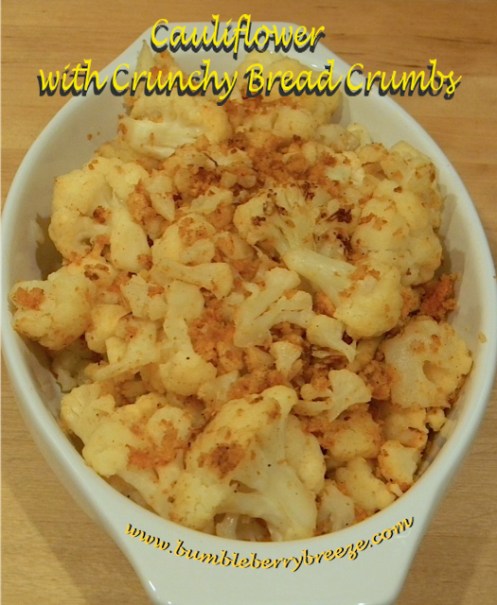
I don’t know about you, but I like to know what I’m eating. Cauliflower is so pretty – I want to retain its structure. So while things like Cauliflower Puff are fine (where you steam and mash the cauliflower, mix with beaten eggs, flour/matzoh meal and seasonings and bake), my favorite ways to prepare cauliflower are roasted (see my Indian-Inspired Cauliflower) with all kinds of seasonings or steamed and smothered with crunchy seasoned bread crumbs. This way, I can admire the pretty little florets, one of the many gifts of Nature. (Man, can I get corny.)
This is the way my mom would make cauliflower for special dinners. But it’s so easy you can do it anytime. Actually she did make it often. It goes so well with stewed chicken or brisket. And it also goes very well with non-saucy main dishes like, burgers, meat loaf, baked chicken, lamb chops… okay, enough already. You know what I mean.

So what’s involved? A piece of leftover bread. I usually have a chunk of leftover Challah in the freezer. But not this time… French Toast Sunday took care of that. But I did have a piece of leftover baguette calling me from the freezer. Its cousin was used in last week’s Tuscan Bread & Tomato Salad (My friend Frank called it my Faux-Tuscan Salad…. ok, Frank, rub it in – we can’t all have just returned from Tuscany).

Send chunks for a spin in a mini-food processor. I use my little one more than the big one, which is in a cabinet somewhere and requires the act of hauling. I try to avoid hauling.

mini-processors are so civilized
Now, stay with me. It gets very complicated. Here we go. Grab a saute pan. Heat up some olive oil. Throw in the bread crumbs. Add some minced garlic. If you don’t want to, then split a clove in half and throw it in. Season generously with salt and pepper.

If you want color, add paprika. Toss in your steamed (if boiled in a little water, then drained) cauliflower and toss to coat well with bread crumbs. Heat through. Done. Or as my friend says, “Done done done.”

With Rosh Hashanah (The Jewish New Year) approaching, we can use some simple dishes that can be prepared in advance and quickly heated through in the oven. The microwave will work too, but you may lose some of that delicious crunchiness. Room temperature is fine too.

So start gathering some simple, delicious and healthful things to prepare so we can focus on what we’re grateful for and what we’ve got as we celebrate the creation of our universe.
Cauliflower with Crunchy Bread Crumbs
Ingredients:
1 head cauliflower, broken into florets 2 T. olive oil 1/2 c. bread crumbs, from stale challah or baguette 1 clove garlic, minced or split salt & pepper a few dashes of paprika, optionalDirections:
Steam or boil (in a small amount of water) cauliflower florets until just barely tender, about 10-14 minutes. Set aside.
Heat saute pan. Add olive oil. Toss in bread crumbs and saute over medium-high heat until the edges begin to brown. Add salt & pepper. Throw in the garlic and continue sauteing until browned through and crunchy.
Turn heat to medium. Add cauliflower and heat through.
Serves 4.
Note: For a dairy meal, add some grated parmesan at the end. Or place in a baking dish, add the parmesan and bake in a medium-hot oven for 15 minutes.
Bonus Rosh Hashanah Recipe: HONEY CAKE…A Lighter Take – click here


 bumbleberry breeze